

Request More Images
You can find images of this object above. Click on an image to zoom.
In case you are looking for additional images, please email us at ritesh@indikeauctions.com or use the request form below.


REGISTERED ANTIQUITY – NON-EXPORTABLE ITEM.
The Ramayana (Adventures of Rama) narrates the epic saga of the valiant Prince Rama and his dutiful wife, Princess Sita, who Ravana abducted, the arrogant ten-headed King of Lanka (probably modern Sri Lanka), during Rama’s unjust fourteen-year forest exile from his capital of Ayodhya (near Faizabad in Uttar Pradesh). To rescue Sita, Rama and his faithful brother Lakshmana assembled a great army of monkeys and bears led by the Monkey-King Sugriva and his Monkey-General Hanuman. After several magical battles, the princess was freed, and the happy couple triumphantly returned home to rule Ayodhya.
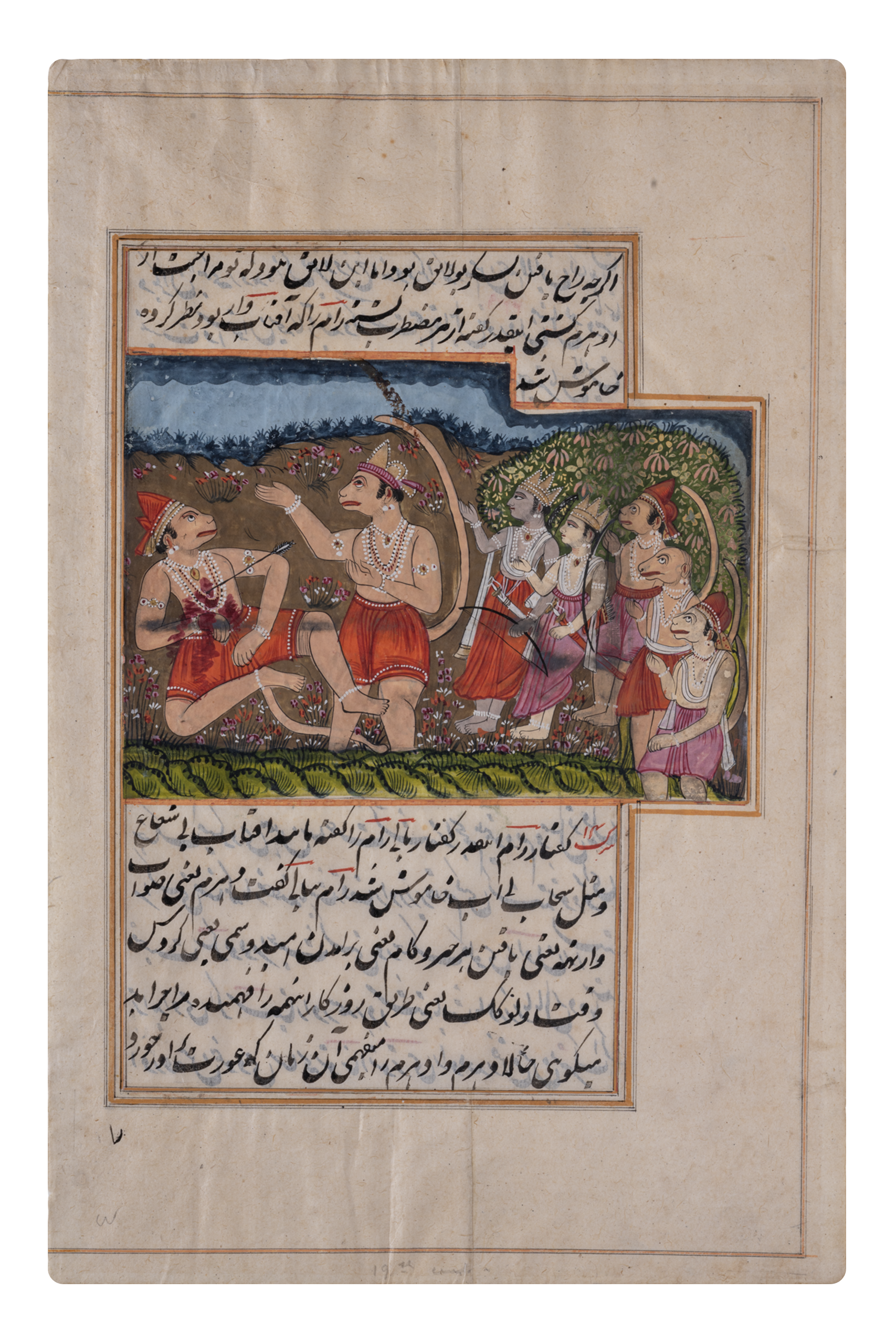
These manuscript folios feature a miniature painting depicting monkey figures that are likely the ‘vanara’ host on whom the Hanumān legend in the Ramayana is based. The work is divided into two panels: the left panel shows two monkeys (Vali and Sugriva) clad in red robes, and the right panel contains a small group of figures conversing. Behind the picture are five more figures, of which the first two are Ram and Lakshman, and the other three figures are Hanuman, Jambuvan and Angad. An emotional scene of grief and pathos, The Death of Vali depicts an incident from the Ramayana, one of the great epics of Indian literature. The painting originally adorned a manuscript of the story. In search of his kidnapped love, Sita, the hero Rama has befriended the king of the monkeys, Sugriva, whose throne has been taken by his evil brother Vali. Rama promises to help Sugriva regain his throne if he and his followers will help search for Sita. Sugriva agrees and then challenges Vali. Just as Sugriva seems to be losing the battle, Rama intervenes, mortally wounding Vali with an arrow. The painting depicts the moment when Vali, close to death, admonishes Rama for shooting him.
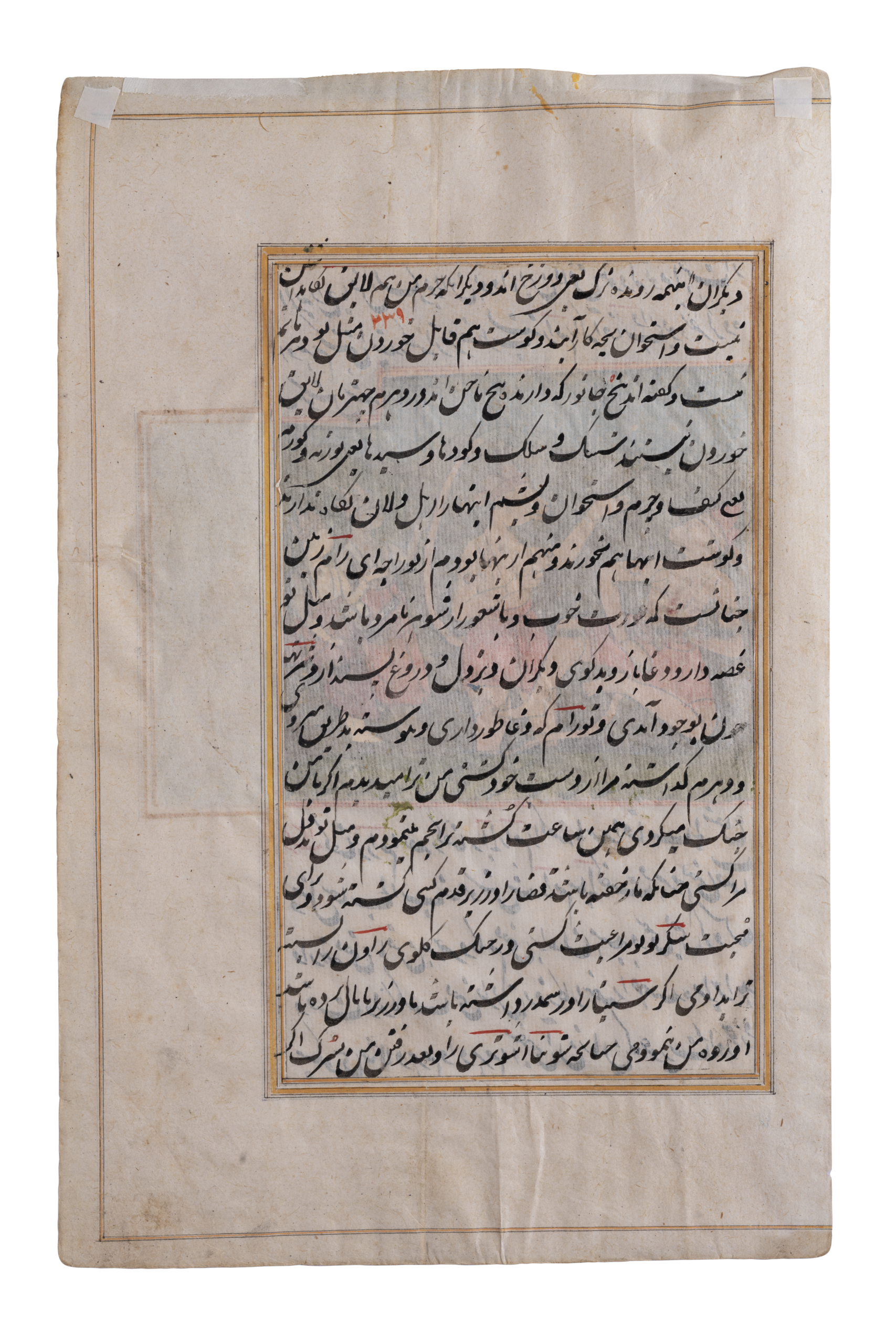
The picture is encircled by Persian (or Persian-script – Nastaliq calligraphy ) inscriptions, both above and below the painted image. These folios can be dated to circa. late 18th century (1780-90) and were definitely not done under Akbar’s reign. The region is Lahore, now in present-day Pakistan. The artists who produced these works were usually not named, and thus gained neither religious merit nor permanent artistic renown. We can surmise that they worked on commission for anyone with the resources and desire for their services.
The total disposition, border treatment, and script style suggest a hybrid vernacular idiom—Indian mythological theme executed within a manuscript folio inscribed in Persian script. This visual and verbal synthesis is reminiscent of illustrated manuscripts generated under Mughal and post-Mughal patronage, which attempted to bridge Indic narrative culture with the Persianate literary universe. These include the clearly documented Persian Translation of the Ramayaṇa (c. 1597–1605), of which some examples have come down in collections like the Rare Books Society of India. These manuscripts reflect a moment of cultural translation in which Sanskrit and vernacular Hindu epics were retranslated for Persian-literate publics, frequently through the agency of visual translations that condensed Indic narratives within the manuscript culture of the Persianate court.
Stylistically, the work is marked by flat areas of colour, stylised foliage, and a simplified approach to landscape features. Such elements direct one towards a regional Indian miniaturist tradition—presumably North Indian—over the highly realistic idiom characteristic of the Mughal imperial workshop. The visual economy and narrative simplicity of the work suggest that it was potentially created for didactic or devotional purposes rather than as a purely courtly luxury item. The inclusion of Persian script also places this folio squarely within the context of cross-cultural manuscript production in the early modern subcontinent, where subjects from Hindu mythology were being shared among Persian-reading elites, reflecting syncretic taste and intellectual exchange of the time.
From a Private Collection in Mumbai, India.
Good condition.
Text panel 24.5cm x 13.5cm, Folio 34.5cm x 22cm.
1. Hanuman Visits Sita in Lanka and Other Exploits, Folio from a Ramayana (Adventures of Rama) India, Gujarat, circa 1775-1800, Drawings; watercolors, Opaque watercolor and ink on paper. 6 1/2 x 12 1/2 in. (16.51 x 31.75 cm). Purchased with funds provided by Christian Humann (M.72.11) https://collections.lacma.org/node/238305?utm
2. A Pahari miniature folio, Death of Vali, Mughal Period, 1780-1800, opaque watercolour and gold, drawing, Purchased with funds from the Libbey Endowment, Gift of Edward Drummond Libbey, Object number 2007.102 https://emuseum.toledomuseum.org/objects/61061/the-death-of-Vali
3. Hanuman in a Persian translation of a Ramayana (1597-1605), Zayn al’-‘Abidin (Indian) Mughal dynasty,Opaque watercolor, ink, and gold on paper, Northern India
Source : Smithsonian Museum https://www.rarebooksocietyofindia.org/postDetail.php?id=196174216674_10150441029911675
4. Earliest Ramayana paintings were in Persian, commissioned by Mughal king Akbar.
03 December, 2022 https://theprint.in/pageturner/excerpt/earliest-ramayana-paintings-were-in-persian-commissioned-by-mughal-king-akbar/1246918/
You can find images of this object above. Click on an image to zoom.
In case you are looking for additional images, please email us at ritesh@indikeauctions.com or use the request form below.
Buying at Indike is simple. Our friendly team of experts are always willing to discuss items entered in the auctions and also those that are currently available in our online shop with potential purchaser. All members of our dedicated team are here to help should you need any assistance. Please note that all items purchased are subject to our standard terms and conditions.

Bid live on our website, without additional online surcharges!

Bids are open until the window closes. Highest bid wins.
By accessing or using this website, mobile application, or any services provided by Indike, you acknowledge and agree to comply with the following terms and conditions. These terms govern your use of our platform and all content, features, and functionality made available through it. Use of this site is conditioned upon your acceptance of and compliance with these terms. If you do not agree with any part of the terms, you must not use the website or services.
All content provided on this site, including but not limited to text, graphics, logos, images, and software, is the property of Indike or its licensors and is protected by intellectual property laws. Unauthorized use, reproduction, or distribution of any content is strictly prohibited.
The information provided on this website is for general informational purposes only and may be subject to change at any time without notice. We do not warrant the accuracy, completeness, or reliability of any content on the site. Any reliance you place on such information is strictly at your own risk.
We reserve the right to suspend or terminate your access to the website without notice, for conduct that we believe violates these terms or is harmful to other users, us, or third parties, or for any other reason at our sole discretion.
You may not use this website in any way that causes, or may cause, damage to the website or impairment of its availability or accessibility. You may not use it for any unlawful, illegal, fraudulent, or harmful purpose or activity.
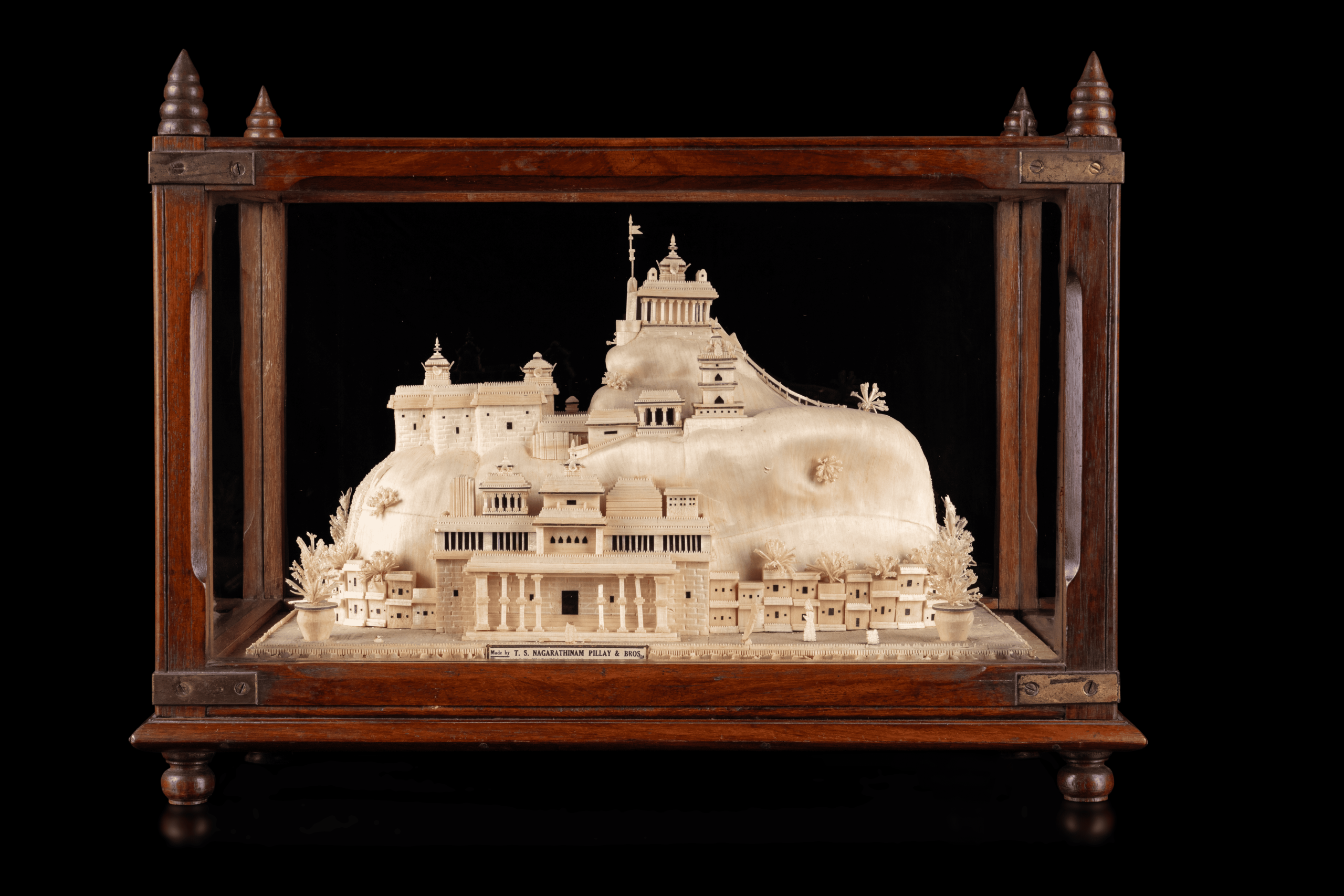
REGISTERED ANTIQUITY - NON-EXPORTABLE ITEM. Object Detail This is a miniature model of Tiruchirappalli Rock Fort in Tamil Nadu. It is made of pith (Indian cork or sola), is an ivory-like delicacy, lightweight nature and capacity for ...read more
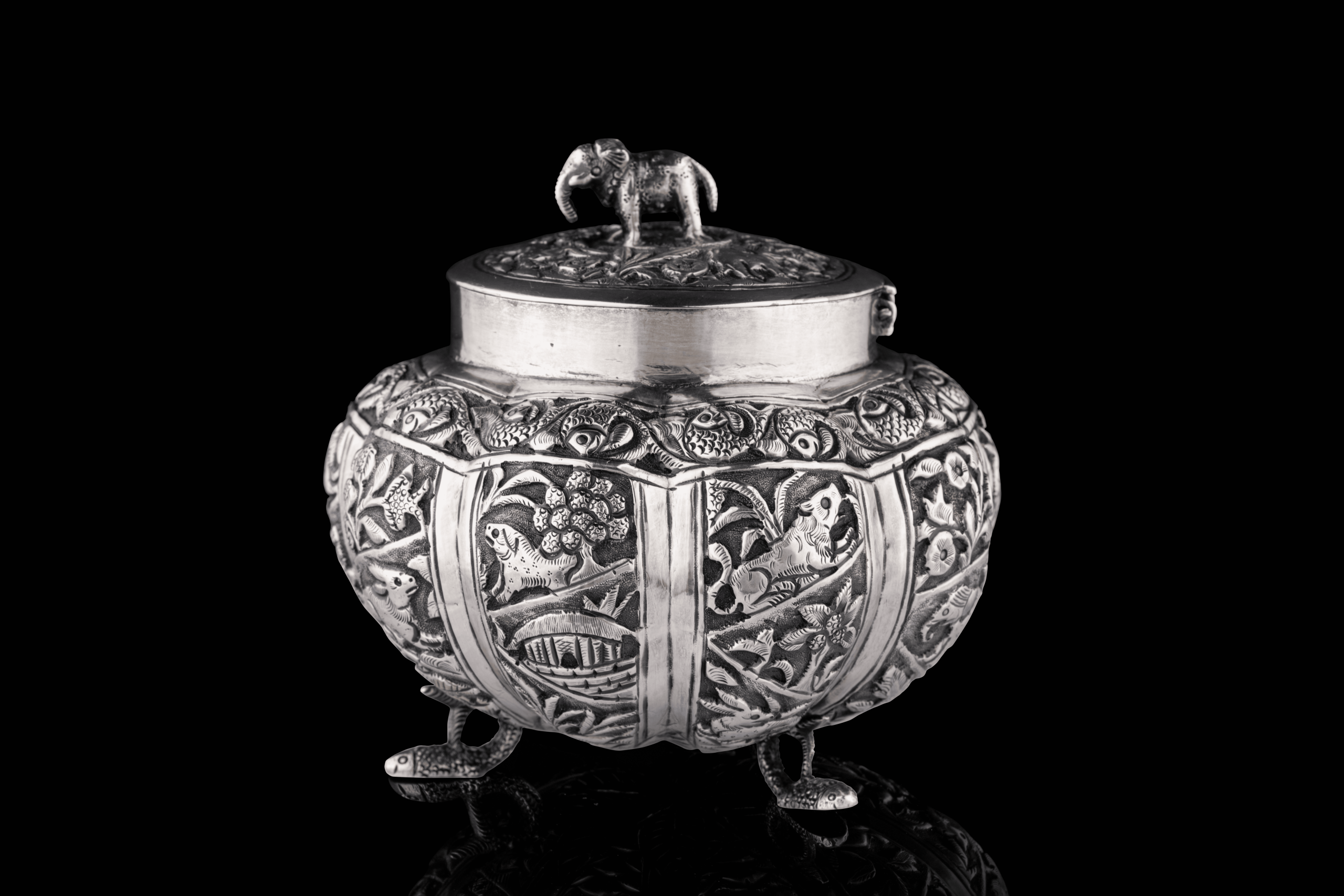
REGISTERED ANTIQUITY - NON-EXPORTABLE ITEM. Object Detail This is a silver tea ware with a beautiful bulbous body that tapers subtly towards the top, culminating in a flat, attachable lid. Its overall globular form is reminiscent of exquisite ...read more
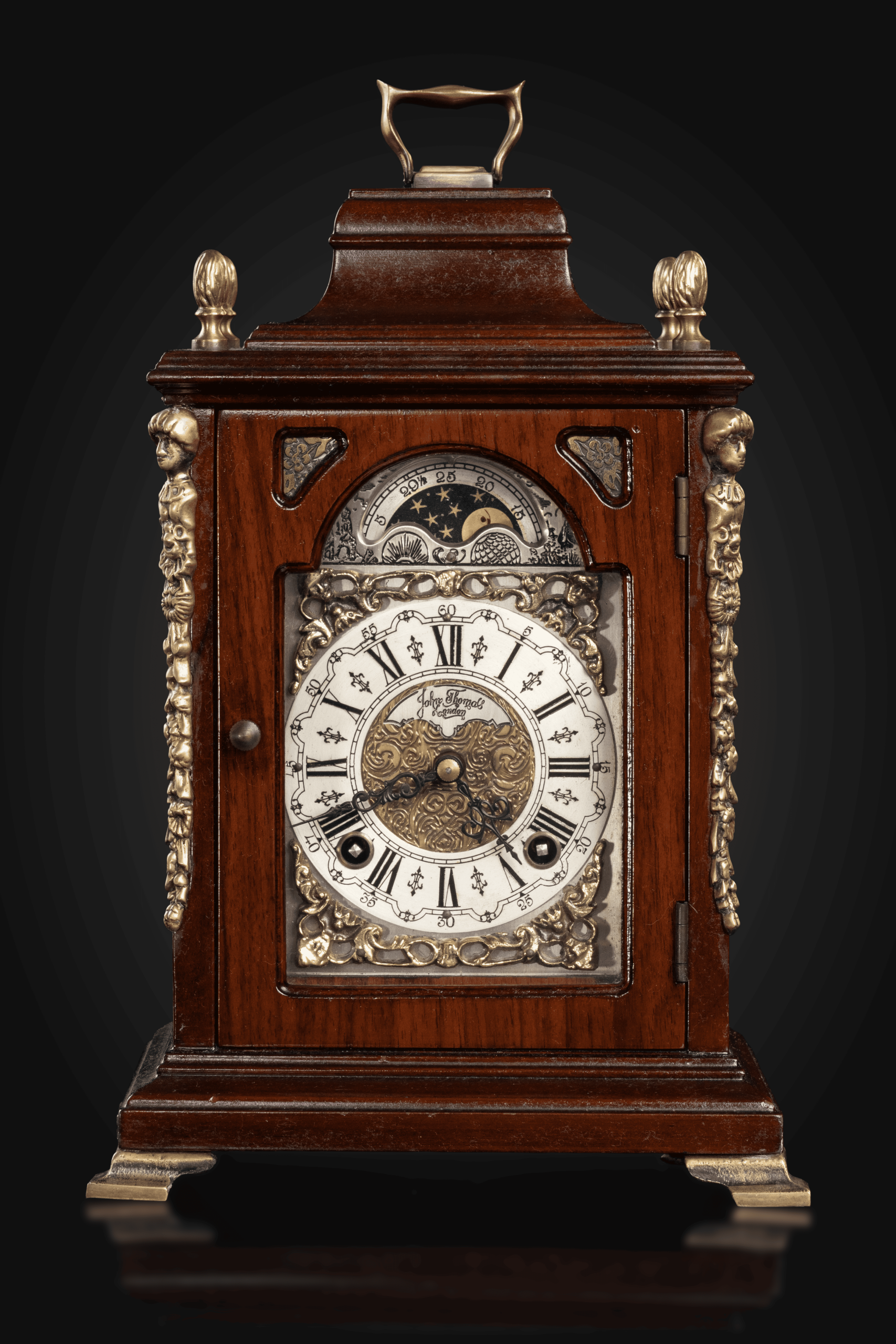
REGISTERED ANTIQUITY - NON-EXPORTABLE ITEM. Object Detail The John Thomas London mantel clock, produced in collaboration with the Dutch manufacturer Wuba Warmink is especially reminiscent of mid-century preferences for elegance moderated with modern efficiency. Auction listings consistently highlight ...read more
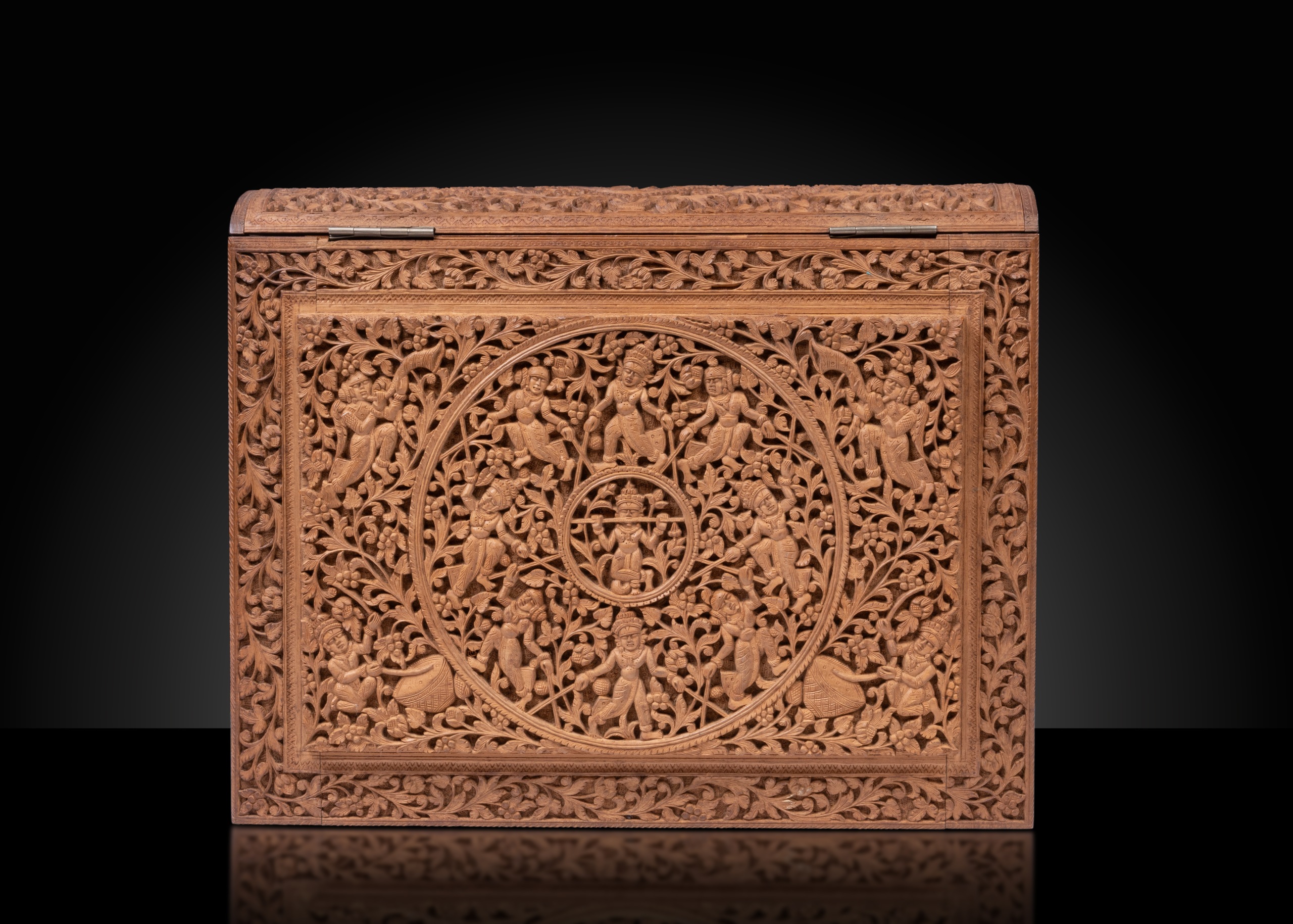
REGISTERED ANTIQUITY - NON-EXPORTABLE ITEM. Object Detail Wood has been masterfully shaped in a myriad of forms to cultivate the vibrant heritage of Gujarat. A remarkable piece dating back to the colonial era is a sandalwood photographic album. ...read more
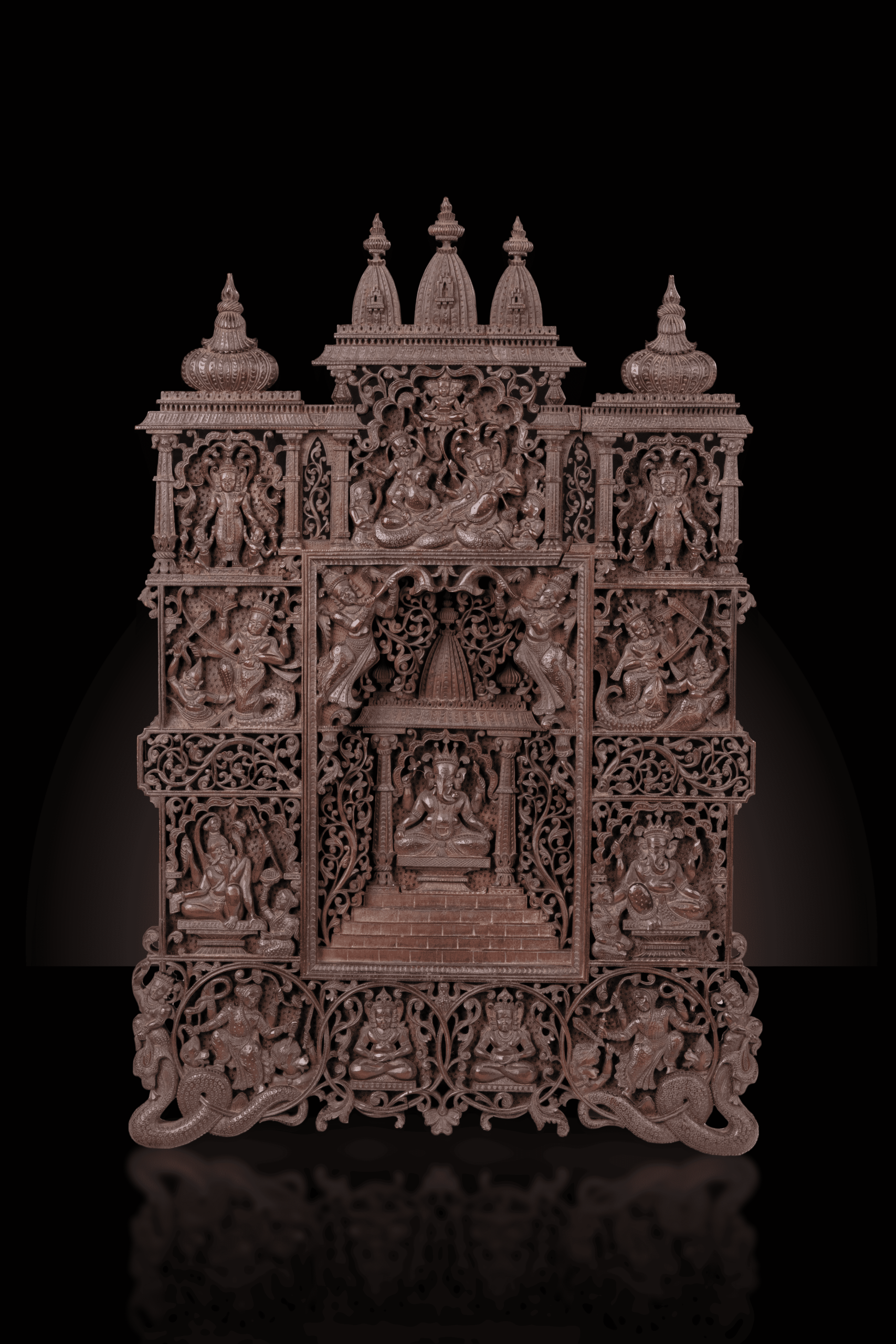
REGISTERED ANTIQUITY - NON-EXPORTABLE ITEM. Object Detail A carved panel from Western part of India, most probably from Gujarat, intricately crafted from rosewood. It is especially valuable due to its intricate amalgamation of Hindu deities alongside the temple ...read more
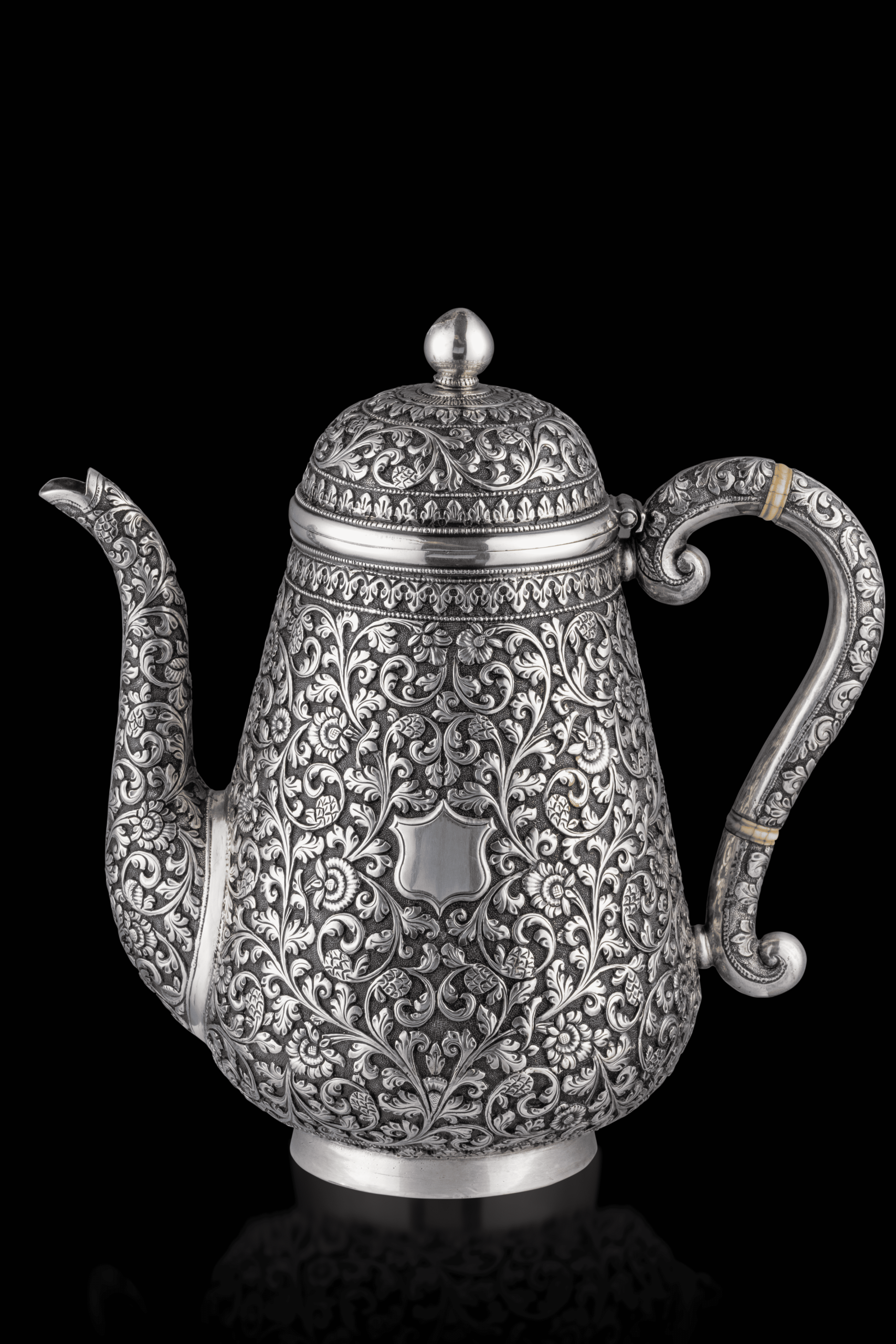
REGISTERED ANTIQUITY - NON-EXPORTABLE ITEM. Object Detail This silver teapot was produced in the 19th century, Kutch, colonial India. Repoussé and chasing techniques were used to shape this teapot. This teapot was possibly part of a larger set ...read more
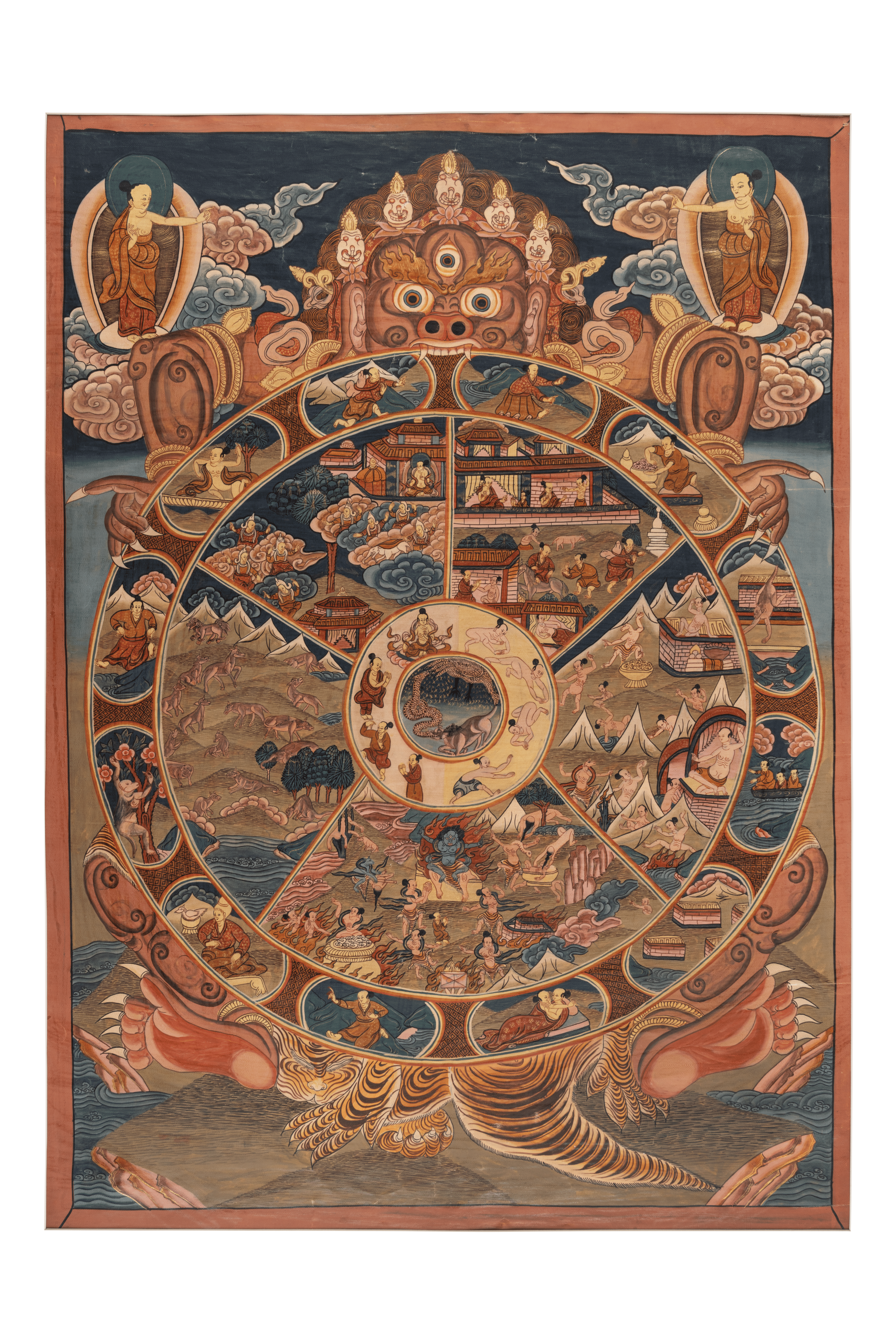
REGISTERED ANTIQUITY - NON-EXPORTABLE ITEM. Object Detail This Thangka depicts the Bhavachakra, which refers to the ‘Wheel of Life or Wheel of Samsara.’ The wheel of life painting graphically illustrates the Buddha’s teaching on impermanence, suffering, karma, death, ...read more
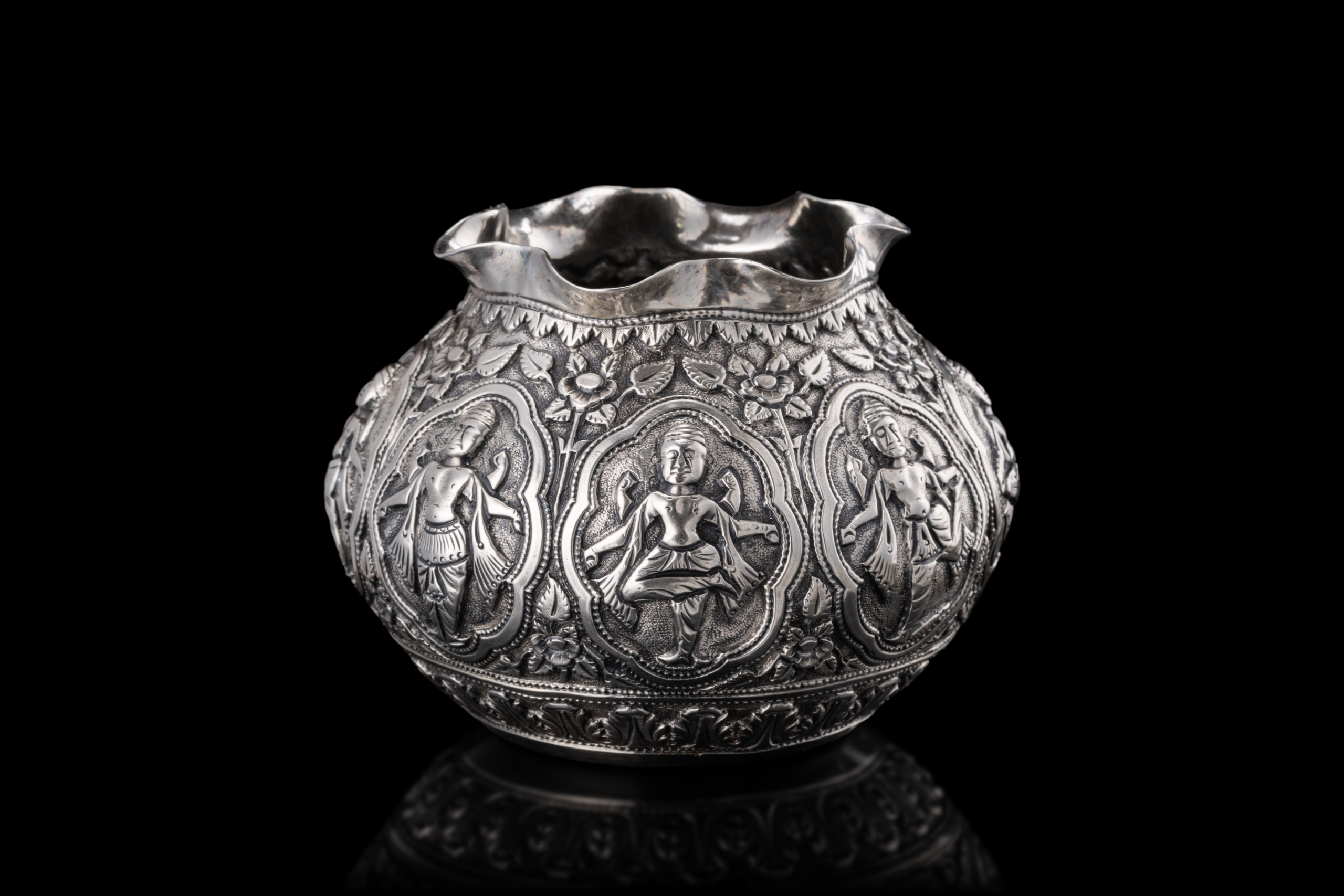
REGISTERED ANTIQUITY - NON-EXPORTABLE ITEM. Object Detail This Silver pot is crafted using the repoussé technique. It opens up like a flower in the moonlight. At the centre, framed within arch-like mandorlas, figures—possibly avatars of Viṣṇu or ethereal ...read more


